


Founded
Eugene Shenk and Ollie Summerlin open Pulse Techniques in Teaneck, New Jersey. Engineering, sales and production: two people.

Every unit is built to the original design specification, by hand, to order. These are not Pultec-style EQs.
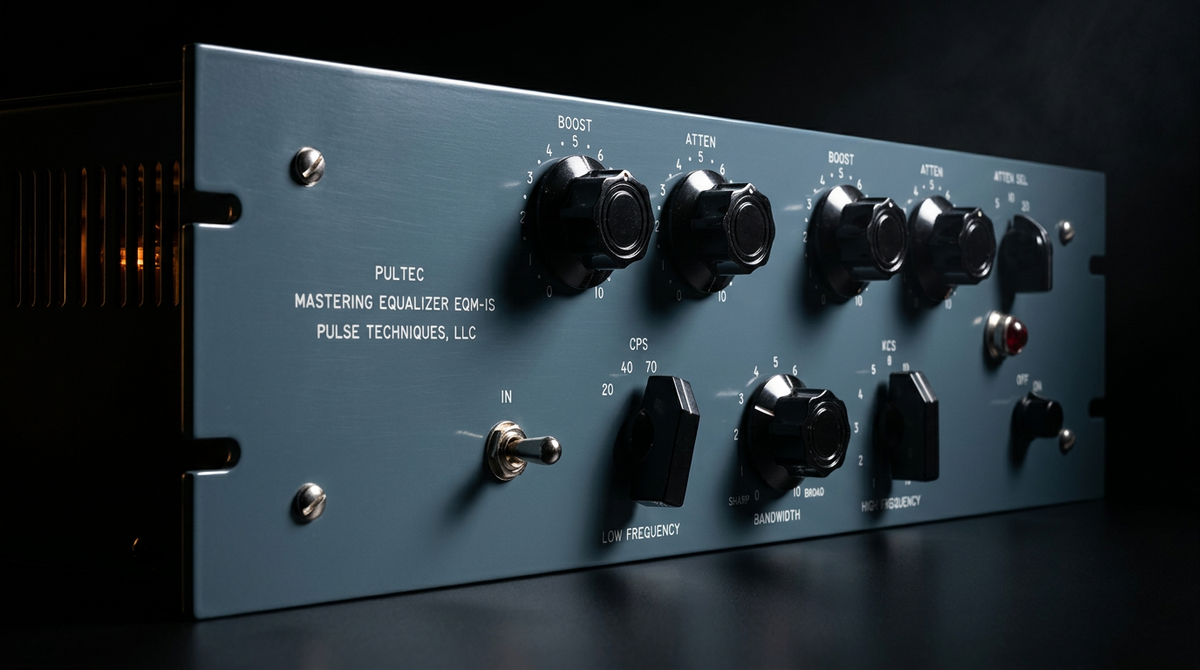
The name gets used as an adjective. Pulse Techniques is a company — founded in 1952, building the same circuit to the same specification, by hand, to order. These are the engineers running the real ones.
 Warren Huart
 Vance Powell
 Tom Dumont
 Stuart Hallerman
 Ross Hogarth
 Rafa Sardina
 Peter Cobbin & Kirsty Whalley
 Kim Rosen
 Kathleen Wirt & Sejo Navajas
 John Rzeznik & Chris Szczech
 Jeffrey Norman
 Jason Mraz
 Jason Livermore
 Jack Douglas
 J.J. Blair
 Greg Wells
 Glenn Rosenstein & Rodney Hall, FAME Studio B
 Geoff Gray
 Eddie Kramer
 Devin Powers
 David Glasser
 Dave Cobb
 Clay Blair
 Chris Lord-Alge
 Brett Allen
 Bob Clearmountain
 Barry Rudolph
 Allen Sides
Eugene Shenk and Ollie Summerlin open Pulse Techniques in Teaneck, New Jersey. Engineering, sales and production: two people.
The 3U program equalizer goes into production. Passive filter network, custom-wound transformers, tube makeup stage.
Rearranged into 2U for crowded racks. The brochure put it plainly: same parts, same specs.
After twenty-nine years, the bench goes quiet.
Steve Jackson begins characterising the original circuit component by component, with Shenk's guidance. The work takes ten years.
The EQP-1 is inducted, alongside the microphone and the multitrack recorder.
Scroll
The boost is a shelf. The attenuator is also a shelf, but its corner sits higher up. Set both at 100 CPS and they do not cancel — the boost wins underneath, the attenuator is still pulling where the boost has run out, and the two combine into a lift below 400 cycles with a dip centred a decade above it. The low end gets bigger and tighter in the same move.
The same argument runs at the top. On its own the 5 KCS boost is a broad hump nearly four octaves wide. Bring the high shelf attenuator in against it and the hump is pared back to a narrow peak, with a shallow dip beneath and a hard roll-off above. Same boost, far more selective — which is why engineers reach for the attenuator when the top needs air rather than noise.
Traced from Pulse Techniques' own Audio Precision measurements of an EQP-1A3.
Production runs, circuit revisions, service notes, and the odd page from the archive. Written when there is something worth saying, which is not weekly.
No discounts, because there are none. Unsubscribe whenever you like.